 Twitter
 Forum
Forum Contact
Haggate
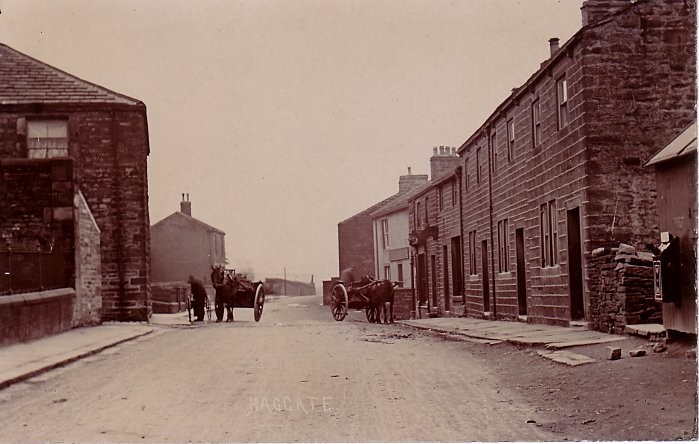 Haggate came into existence in the 17th century and, by the 1640's, there were several families living there; the Hitchin's, the Ridehalgh's, the Smith's and the Higgins'.
It appears the growth of the village was the result of two developments. The first was the increase in travel and the second was the growth in the textile industry. The latter coincides with the involvement of the Smiths of Hill End, properly Haggate Hill End, and the Ecroyds of Foulds House, in the woollen industry.
The derivation of the name has produced a number of suggestions. Walter Bennett favours the explanation that the name comes from 'hatch gate', a gate at the junction of two manors. This could be the case as Haggate is not far from the boundary between the Manors of Ightenhill and Colne, and the road through Cockden leads to the Manor of Extwistle. It has also been suggested that the name comes from 'Algotholmegate', meaning a gate or road to the home of Algantre.
Hagg is Norse for a place cleared of trees, which, if the name comes from this source, could indicate very early settlement. However, Roger Frost thinks that the clue to the meaning of the name of the village can be foubd in the earliest known spelling of the place name. Hack, as in the 1640 version of Hackgate, is a reference to a thorn tree, usually the hawthorn. It is till referred to as the 'hack tree in several places. Roger says he can't be sure of the derivation of the first syllable of the word but the second seems to be somewhat easier. 'Gate' should be seen in the same sense as Sandygate and Finsleygate in Burnley; that is, as a 'walk or road'. As Haggate stands at a crossroads which was of considerable importance in the past it seems a possible explanation.


